GUIDE
How to write an Australian CV as an international student

A CV that worked well at home might not land the same way in Australia. The conventions are a little different, and as an international student you have one extra thing to explain: your right to work.
This guide covers what Australian employers usually expect, with a sample outline based on Alex Morgan, a made-up student whose CV we made in StepWise.
Australian CV conventions
Length
Aim for about two pages. Government careers guides suggest two pages or fewer (Australian Human Rights Commission; Jobs and Skills WA).
Whatever the page count, the test is the same: every line should help the reader decide to call you. If a line doesn’t, cut it.
What to leave out
You don’t need to include personal details such as your date of birth or a photo (Australian Human Rights Commission). A photo is generally left off unless the employer asks for one (Jobs and Skills WA).
Also leave out:
- Your full street address. Your suburb and state, such as “Sydney, NSW”, is enough.
- Your passport number, TFN or bank details. Nobody needs them to read your CV. You give your TFN to your employer once you’re hired (ATO).
- Old school results, once you have university study or work to show.
How it reads
- Most recent first, in each section.
- Short bullet points that start with a verb: “Handled”, “Trained”, “Resolved”.
- Numbers where you have them: how many customers a shift, how many people on the team.
- Australian spelling, used consistently: “organisation”, “colour”, “centre”.
Your visa and work rights line
Make it clear that you can work, and for how many hours, before an employer has to ask. One line under your contact details does it.
Alex’s CV says:
Visa & work rights: Student Visa 500 (48 hrs / fortnight)
Student visa (subclass 500) holders can usually work up to 48 hours a fortnight while their course is in session, and unlimited hours during scheduled course breaks. You can’t start work before your course starts (Study Australia).
Make sure your line matches your own visa. If your conditions are different, or they change, update your CV the same day. Don’t guess: check your visa grant letter, or VEVO.
VEVO (Visa Entitlement Verification Online) shows your visa conditions and work rights. Check it before you start or change jobs (Study Australia).
Local experience and volunteering
Experience in Australia, even a few months of it, shows an employer how you work here. If you’re new, you can start building it quickly:
- Casual and part-time jobs count, including hospitality and retail. They show reliability and customer service.
- Volunteering counts too. Put it under “Experience” with the same bullet points you’d use for a paid role, or give it its own “Volunteering” heading.
- Uni roles such as club committees, peer mentoring and events.
GoVolunteer, an initiative of Volunteering Australia, matches people with volunteering roles across the country (Volunteering Australia).
Don’t hide your overseas experience. Keep it, and describe it in terms an Australian reader will recognise: what the business did, how big it was and what you were responsible for.
Referees
A referee is someone an employer can contact to ask about you: usually a recent manager or supervisor, or a lecturer if you haven’t worked yet.
List at least two referees, with their name, job title, employer and contact details. If you can’t get their details in time, write “Available on request” and have them ready if you’re invited to interview (Jobs and Skills WA; Australian Human Rights Commission).
Alex’s CV says “References can be provided upon request”, so Alex needs referees’ details ready before any interview. Whichever you choose, always ask your referees first, and tell them which jobs you’ve applied for so they’re ready for the call.
A simple example outline
Here’s the outline of Alex’s CV. Alex is a made-up student, and the details are invented.
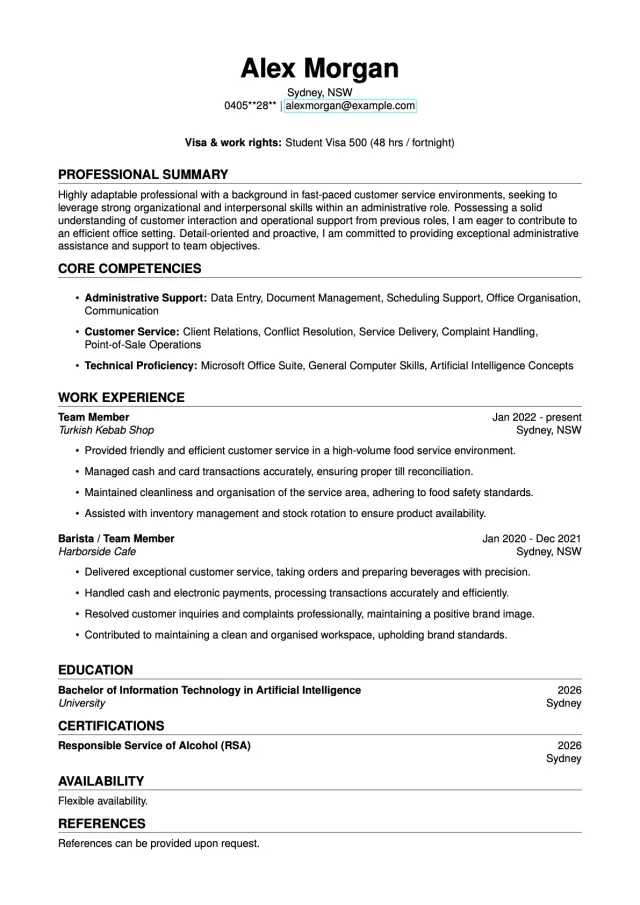
- Name and contact details: Alex Morgan, Sydney, NSW, a mobile number and an email address.
- Visa & work rights: one line, as above.
- Professional summary: a few sentences on the kind of role Alex wants (administration) and the strengths from previous roles (customer service, organisation).
- Core competencies: three short groups: administrative support, customer service and technical skills.
- Work experience, most recent first:
- Team Member at a kebab shop in Sydney, Jan 2022 to present: customer service, cash and card transactions, food safety, stock.
- Barista and Team Member at a cafe in Sydney, Jan 2020 to Dec 2021: orders, payments, complaints, a clean workspace.
- Education: Bachelor of Information Technology in Artificial Intelligence, finishing 2026.
- Certifications: Responsible Service of Alcohol (RSA), 2026. In NSW, anyone who sells, serves or supplies alcohol must complete RSA training, then get an NSW RSA competency card through Service NSW (NSW Government).
- Availability: “Flexible availability.”
- References: “References can be provided upon request.”
You could make Alex’s summary stronger by naming one result, such as a busy shift handled without complaints, and by matching its wording to the job ad.
PDF or Word?
- PDF keeps your layout exactly as you made it, on any device. It’s the safe default when you email a CV or upload it.
- Word is useful when a recruiter asks for an editable file, or a job portal asks for a .docx.
- If the job ad says which format to send, use that one.
StepWise gives you both, in A4, plus a share link that lasts 30 days if you’d rather send a link.
Common mistakes to avoid
- No work rights line, so the employer has to guess.
- A one-size-fits-all CV. Adjust your summary and skills for each job.
- Long paragraphs instead of short bullet points.
- Unexplained overseas job titles. Add a few words on what the role involved.
- Typos in your email address or phone number. Send yourself a test email.
- Mixing spelling, such as “organisation” in one line and “organization” in the next.
- An unprofessional email address. Use your name.
- Including things to leave out, such as a photo or your date of birth (see above).
- Forgetting to update dates, such as “present” for a job you’ve left.
- Tapping links in unexpected texts while you’re job hunting. Scam texts and calls often pretend to be your bank, telco or a delivery company. Use the organisation’s own app or website instead, and never share passwords or one-time codes (ACMA).
When you get the job
Congratulations. A few things to know from day one:
- Give your employer your TFN so the right amount of tax comes out of your pay (ATO). If you don’t have one yet, our first week checklist explains how to apply.
- Your employer has to give you a payslip within one working day of paying you, even if you’re paid in cash (Fair Work Ombudsman).
- Write down your start and finish times for each shift, so you can check your payslips (Fair Work Ombudsman).
- Most employees have super paid by their employer into a super fund. From 1 July 2026, employers pay it with each payday (ATO).
Just arrived? Start with our Sydney Airport arrival guide.
Sources
- Apply for a TFN: foreign passport holders, permanent migrants and temporary visitors (ATO)
- I'm not getting pay slips (Fair Work Ombudsman)
- Super from your employer (ATO)
- Phone and SMS scams (ACMA)
- Writing a resume and cover letter (Australian Human Rights Commission)
- Creating a great resume (Jobs and Skills WA)
- Student visa (subclass 500) (Study Australia)
- GoVolunteer (Volunteering Australia)
- RSA training (NSW Government)
Related guides
- First week in Australia: a checklist for international students
A first-week checklist for international students in Australia: SIM, bank, TFN, transport card, health cover, student ID, your address and emergency numbers.
- Sydney Airport arrival guide for international students
Landing at Sydney Airport as a student: where to meet your pick-up, the train, rideshare or taxi to the city, paying with Opal, a SIM and your first night.